
Fintech Independence: MTN Uganda’s Structural Shift

Following board approval in March 2025, MTN Uganda shareholders consented to the unbundling of MTN Mobile Money (MoMo) at an extraordinary general meeting on 22nd July 2025. This follows a broader pattern. In neighbouring Kenya, persistent pressure continues to build for the separation of the country’s largest mobile money platform, M-Pesa, from its telecom parent, Safaricom. Additionally, the MTN Group itself is undergoing similar restructuring in Ghana and Nigeria as part of its Ambition 2025 strategy.
Across African capital markets, banks and telecoms command the highest valuations and dominate investor portfolios. MTN Uganda is already the country’s largest publicly listed company. Therefore, as both regulators and executives push for the independence of Uganda’s largest fintech, the question is whether this move will deliver on its promise of inclusion, innovation and investment?
Compliance and Opportunity
MTN Uganda shareholders officially approved the structural separation of MTN Mobile Money (U) Limited at an extraordinary general meeting. Under the proposed structure, the FinTech arm of the company will be transferred to a new entity, MTN New FinCo, which will operate independently of MTN Uganda. MTN Group will have a 76.015% stake in this new company whilst a trust will manage the remaining 23.985% on behalf of MTN Uganda’s shareholders. After a transition period, the trust will be dissolved and MTN Uganda shareholders will be left with two separate interests in two separately listed companies. This is illustrated in the figure below.
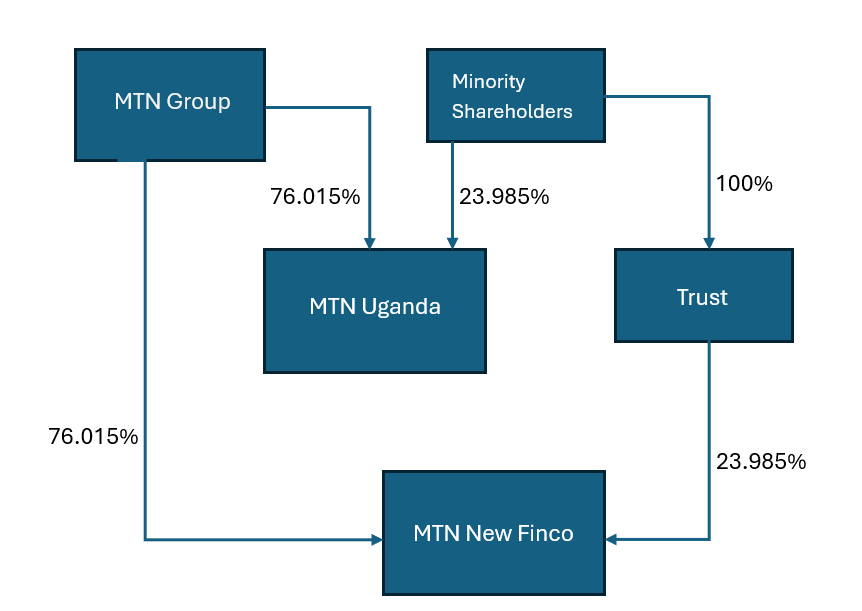
The rationale behind MTN Uganda’s unbundling is threefold: regulatory compliance, capital mobilization, and operational focus. Firstly, the move ensures the company meets regulatory requirements. Specifically, those outlined in the National Payment Systems Act (2020) which require payment service providers (PSPs) to be run independently and bar the use of airtime as a substitute for money.
Secondly, by separating MoMo from its telecom operations, MTN creates a distinct entity capable of raising dedicated FinTech capital. This would come from venture capital and, in three to five years, public markets through an Initial Public Offering (IPO). It is worth noting that PayPal, which went public for the second time in 2015 after being spun-off from eBay, is one and a-half times worth its former parent company. Interestingly, it passed its former parent in its first day of trading.
Thirdly, this operational independence also encourages strategic partnerships and innovation beyond payments into credit, savings, insurance, and investment products. These all fit into MTN’s broader Ambition 2025 strategy, which is centred around building Africa’s largest and most valuable platform.
A Continental Realignment
MTN Uganda’s move follows a pattern emerging across the continent. In Kenya, Airtel transferred its mobile money services to a new entity called Airtel Money Kenya Limited in 2022. Additionally, the Kenyan government is weighing up a plan to split up Safaricom into three separate companies. Respectively, its core telecom business, a tower operator and mobile money platform, M-Pesa.
Elsewhere, as the MTN Group implements its Ambition 2025 strategy, it is in the process of spinning off its mobile money services in Ghana and Nigeria. The process is more advanced in Ghana and follows a similar structure. The group’s mobile money service will be spun off from Scancom PLC (MTN Ghana) into a new entity called New FinCo.
These developments reflect a broader regulatory shift. Regulators increasingly recognize FinTech platforms not merely as payment facilitators but as an integral part of their respective financial systems. For instance, in Uganda, transaction volumes on mobile money platforms are over 50% of the country’s GDP. This recognition has prompted the regulatory push for operational independence seen across the continent.
Fintech Valuation Proposition
Telecom-FinTech hybrids and banks dominate African exchanges. MTN’s local subsidiaries are the largest publicly listed companies in both Uganda and Ghana, with FinTech revenues are increasingly driving their respective valuation multiples. Safaricom alone accounts for nearly 40% of the Nairobi Stock Exchange’s market capitalisation. This trend is illustrated in the figure below.
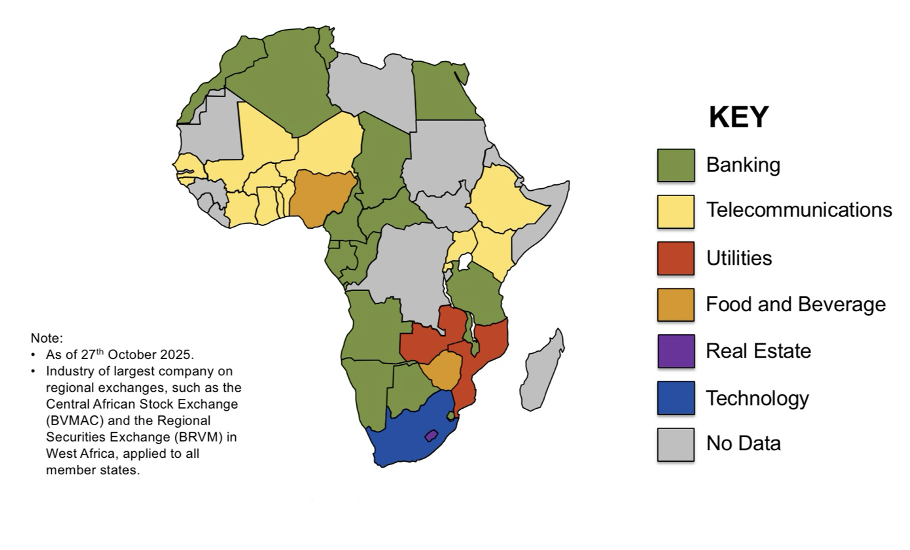
Figure 2. Industry of Largest Listed Company by Market Cap. Source
As these companies separate their FinTech arms, a new generation of African IPOs is likely to emerge, with clearer growth narratives and more focused investment cases. MoMo’s scale in Uganda is already formidable. According to the company’s 2024 Annual Report, the platform boasted 4.3 billion transactions worth over UGX 158.6 trillion – $45.5 billion. The platform has 13.8 million subscribers while MTN Uganda’s telecommunications arm has 22 million users. However, MoMo is a more profitable segment of the company. It has a 27% profit margin compared to the 17.4% margin of MTN Uganda’s telecommunications business.
Nevertheless, there is still room for growth. MoMo’s pivotal role as a circulatory system of the Ugandan economy makes its top line and transaction volume proxies for economic activity – particularly consumer expenditure. With the world’s second youngest population, and an economy buoyed by oil-related investment and soon production, the pie MoMo is targeting looks set to get bigger.
Similarly, as an independent company with clearer regulations, MoMo can accelerate its growth. Primarily by deepening or establishing partnerships and developing new products to help it penetrate into new sectors. MoMo already has existing collaborations with Mastercard, Diamond Trust Bank, and Network International, which enabled the issuance of a Mastercard virtual card. This allowed users to make international e-commerce payments and use the MoMo wallet around the world. Looking forward, new opportunities lie ahead in SME solutions, digital credit, and investment products. Particularly, as the company looks to add value and reinforce its role as a central player in Uganda’s financial ecosystem, instead of merely being a gateway to the country for multinationals.
Consequently, investors are bound to be intrigued by the prospect of getting direct access to MoMo. Particularly without exposure to the capital expenditure heavy telecommunications segment of MTN Uganda. The company spent UGX 319.7 billion – $91.8 million – on adding to its telecommunications equipment in 2024. Together with the threat of competition from companies like SpaceX’s Starlink, which enters Uganda in 2026, MTN Uganda’s bottom line and value proposition is under threat from competitors look to gain market share.
Separation Anxiety
It is important to note how MoMo is tied to the company’s telecommunications network. The platform is only accessible to those with an active MTN Uganda SIM card. This has provided MoMo with a dominant advantage over its competitors as it leveraged its extensive user network to create a digital service ecosystem. The two companies are almost certainly going to maintain this relationship, which has made Uganda’s mobile money market a duopoly between the country's two largest telecommunications companies, Airtel and MTN.
Additionally, Bank of Uganda (BoU)’s push for interoperability between mobile money platforms promises to lower the barriers to competition in the country’s mobile money market. Initially announced in 2022, BoU plans to establish a unified platform that links banks, mobile money platforms, and FinTechs in a single ecosystem. Furthermore, it will ease regional integration initiatives such as the East African Payment Systems (EAPS) and the COMESA Regional Payment and Settlement System.
This initiative promises to reduce fragmentation and transaction costs as operators share infrastructure and agent networks. However, put together, these developments could be seen to erode the moat safeguarding MTN Uganda’s business from competitors. Reduced requirements in capital expenditure and a unified national platform promise to level the playing field for commercial banks, internet service providers, and startups.
Conclusion
MoMo’s unbundling is not simply corporate restructuring; it represents a fundamental reclassification of what mobile money has become in Uganda. What began as a convenient add-on to telecom services has evolved into critical financial infrastructure. The separation acknowledges this reality; MoMo is no longer a value-added service but the circulatory system of Uganda’s digital economy. For investors, the opportunity is clear but nuanced. MoMo offers exposure to a high-margin, fast-growing fintech platform serving millions in one of Africa’s youngest and most dynamic markets. Yet the investment case depends on how well the company navigates emerging challenges. Particularly increased interoperability as well as new competition from banks, startups, and even satellite internet providers threatening its telecom parent.
The real test will be whether independence delivers what it promises: accelerated innovation, strategic partnerships, and deeper financial inclusion. If MoMo can leverage its regulatory clarity and operational focus to expand further into credit, savings, and regional payments, this move could become a blueprint for how Africa’s fintech giants mature. But if it remains tethered to legacy advantages, such as distribution through MTN sim cards and a protected duopoly, the unbundling will have merely reshuffled corporate structure without unlocking new value. The next few years will reveal not just MoMo’s trajectory, but the future architecture of African finance itself.
